

A Midsummer Night's Dream Snout
| Helena | |
|---|---|
| A Midsummer Night'southward Dream character | |
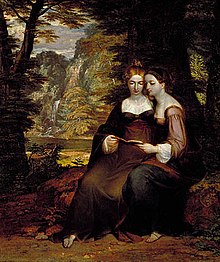 Washington Allston'southward 1818 painting Hermia and Helena. | |
| Created by | William Shakespeare |
Helena is one of the 4 young lovers – the others being Demetrius, Lysander, Hermia – featured in William Shakespeare'southward play A Midsummer Night's Dream.[1]
Function in A Midsummer Night'south Dream [edit]
Helena, the daughter of Nedar, is the lifelong friend of Hermia (whom she often compares herself to). Before the events of the play, Helena was matrimonial to the nobleman Demetrius, just she was jilted when his angel turned to Hermia. Despite this, Helena's abiding love for Demetrius remains consistent throughout the play. Hermia and her suitor, Lysander, confide in Helena that they program to elope. In the hopes that she volition gain back some of Demetrius' respect, Helena tells him of Hermia and Lysander'due south plans and they follow the escaping lovers into the forest.
Though Demetrius is deliberately cruel towards her, Helena remains truthful to her devotion. Her ardor catches the attention of Oberon, who commands that Puck enchant Demetrius so that he will fall dorsum in love with Helena. When Puck mistakenly enchants a sleeping Lysander instead, Lysander wakes and falls instantly in love with Helena. He pursues a shocked and injure Helena, deserting a sleeping Hermia. Oberon, trying to correct Puck's mistake, and so puts the potion on Demetrius, who as well falls in beloved with Helena. Confused by the men's change in beliefs, Helena is left confused and hurt by how brutal and unkind her closest friend and her ii suitors have become. In the climatic fight, she and Hermia nearly come to blows while the two men fight over who is more worthy of Helena'due south affections.
Oberon commands Puck to correct the enchantment placed on Lysander. Separated past Oberon'due south command and Puck'south magic, and with dawn approaching, the lovers each go to sleep again. Puck crushes some other herb into Lysander's eyes, negating the outcome of the first 1. When the lovers are discovered in the morning by a hunting Theseus, Hippolyta, and Egeus, all is put to rights. Demetrius claims that a metaphorical 'sickness' made him dear Hermia, but in wellness, his dearest has returned to Helena. The lovers are married in a joint ceremony with Theseus and Hippolyta and together lookout the play put on by the Mechanicals in laurels of the marriages.
While not the but protagonist of A Midsummer Night'south Dream, Helena is one of its most talkative characters.[ii] Her dialogue provides key insight for the audience into humanist beliefs on the nature of love and the process of falling in beloved. Information technology is her honest, unrequited dear that convinces Oberon to meddle with the lovers, and her hurting in being "tricked" by her friends that convinces Oberon to restore everyone.
Helena is never criticised for her unrequited love for Demetrius; her constancy is seen by other characters as a great virtue, compared to his fickle nature. She also demonstrates great ideal dear and sisterly devotion to Hermia. Within the bandage of the lovers, her role is comparable to Lysander's. Both are more than outwardly romantic and thoughtful than their partners, and both speak those lines almost pertinent to the play's themes of romantic maturity and the source of lasting beloved. While Lysander says, 'the form of true dearest ne'er did run smooth', Helena's oral communication in Human activity I includes the well-known quote: "Love looks not with the eyes, but with the mind; And therefore, is wing'd Cupid painted bullheaded."
Her name is reminiscent of Helen of Troy, a reference made by Theseus towards the play'south end, and her character is similar to another of Shakespeare'due south Helenas in All'due south Well That End's Well.
References [edit]
- ^ "Helena - Characters - KS3 English Revision". BBC Bitesize . Retrieved 6 September 2022.
- ^ "All Shakespeare characters ordered past function size". ShakespeareWords.com. Retrieved 10 August 2013.
{{cite web}}: CS1 maint: url-status (link)
- Shakespeare, William & Gill, Roma (ed.)1981, "A Midsummer Dark's Dream", Oxford Academy Press, Great britain.
- Shakespeare, William. A Midsummer Night's Dream. "The Penguin Shakespeare." Penguin/Puffin Books, 1977.
- Jacobson, Karin. CliffsNotes on A Midsummer Night'southward Dream. 15 November 2010 <https://spider web.archive.org/web/20110613191544/http://world wide web.cliffsnotes.com/study_guide/literature/id-78.html>.
- Shakespeare, William. A Midsummer Night's Dream. Evans, Bertrand, ed.; Lynch, James J., ed. The Merchant of Venice, A Midsummer Night's Dream. New York: The Macmillan Company, 1963. 131–238.

A Midsummer Night's Dream Snout,
Source: https://en.wikipedia.org/wiki/Helena_(A_Midsummer_Night%27s_Dream)
Posted by: dudapeoppon.blogspot.com
0 Response to "A Midsummer Night's Dream Snout"
Post a Comment